

GLOBAL &
Beyond Dim Sum and Dumplings:
Why Chinese Dining in America Is Entering Its Golden Age
2026. Jul 2. INSIGHTS
−
There was a time when Chinese food in America meant one thing: takeout.
Orange chicken. Chop suey. Fortune cookies.
That era is still visible. It’s just no longer the story.
Because right now, Chinese and Taiwanese dining in the United States is doing something far more interesting than “reinventing itself.” It’s correcting decades of misunderstanding.
Chinese food was never one cuisine. It was never one style. It was never meant to sit inside a single menu category.
That confusion didn’t come out of nowhere.
For decades,
Chinese restaurants in America were concentrated in Chinatown districts. They were affordable, everyday places built for immigrant communities and local neighborhoods. Over time, that accessibility shaped perception. Cheap became shorthand for “simple.” Familiar became mistaken for “limited.”
That idea stuck. But it doesn’t hold anymore.
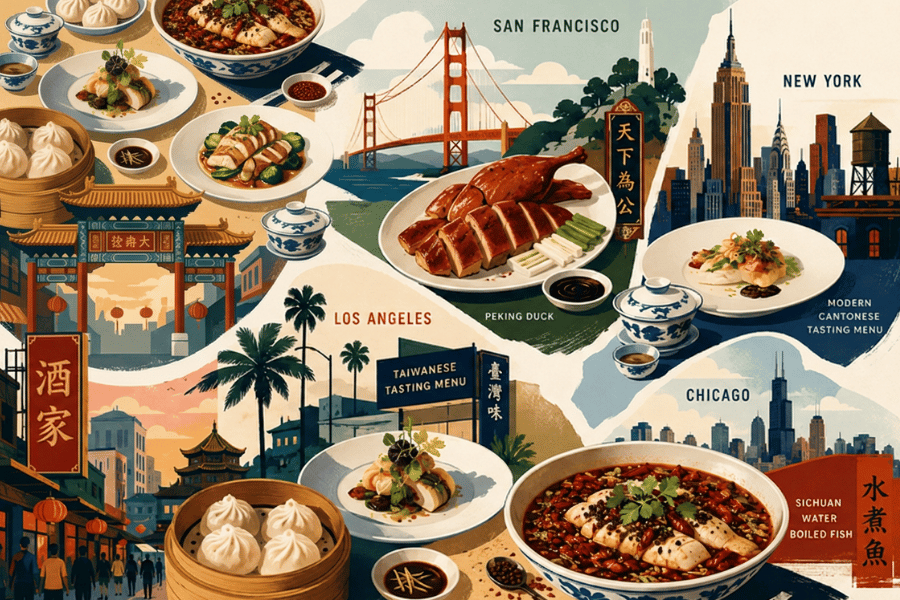
On any given night, you can eat Peking duck in San Francisco, reimagined Taiwanese tasting menus in Los Angeles, modern Cantonese tasting menus in New York, or Sichuan “water-boiled fish” in Chicago. This is not novelty anymore. It’s the landscape.
And it changes everything.
Lucas Sin, New York-based chef, sees this clearly. Diners, he suggests, are finally moving past the old obsession with “authenticity.” That word used to flatten Chinese cuisine into something defensive. Now it feels outdated.
What matters instead is region. Memory. Precision. A sense of place.
Why should Sichuan food taste like Cantonese food? Why should one “correct” version of dumplings represent an entire country? The conversation is finally catching up to reality.
But there’s another layer people still miss: Chinese American food is not a compromise. It is its own cuisine.
Virginia Miller, San Francisco–based dining writer and judge, is blunt about this. Chinese American restaurants are not diluted versions of something “real.” They are one of the defining immigrant food cultures in the United States. Full stop. They evolved here. They belong here. And for many Americans, they were the first entry point into Chinese food at all.
That history matters. But so does what comes next.
Because today’s Chinese dining scene is no longer defined by affordability or accessibility alone. It is defined by ambition.
A new wave of restaurants is pushing deeper into regional Chinese cooking than most American diners have ever experienced. Not fusion. Not adaptation. Specificity.
That shift also comes with a change in pricing—and perception.
What was once expected to be “cheap” is now being recognized for what it always contained: serious technique, labor-intensive preparation, and culinary knowledge systems that rival any global tradition. The price is higher in many cases, yes. But so is the level of craft. The value equation has changed.
Vivien Sin, San Francisco–based entrepreneur, puts it more simply: the sophistication was never missing. The understanding was.
Knife work. Fermentation. Live seafood. Wok control. Dim sum precision. Tea culture. Roasting traditions. These aren’t emerging techniques. They’ve always been there. What’s changed is that diners are finally paying attention.
That attention is reshaping what “good” looks like in Chinese dining.
A great Chinese restaurant is no longer measured by how closely it fits Western fine dining rules. In fact, the best ones increasingly ignore those rules entirely.
A neighborhood noodle shop can matter just as much as a tasting menu. A Cantonese seafood restaurant can be just as technically ambitious as any French kitchen. A Taiwanese diner can carry as much cultural weight as a Michelin-starred room.
Different formats. Same seriousness.
And here’s the real shift:
Chinese and Taiwanese chefs in America are no longer trying to explain themselves.
They’re done doing that.
Instead, they’re cooking with confidence. With specificity. With memory. With regional identity intact.
That confidence is what defines this moment.
Not a trend. Not a “moment” in the superficial sense.
A correction.
Chinese dining in America is no longer asking for a seat at the table.
It’s building its own.